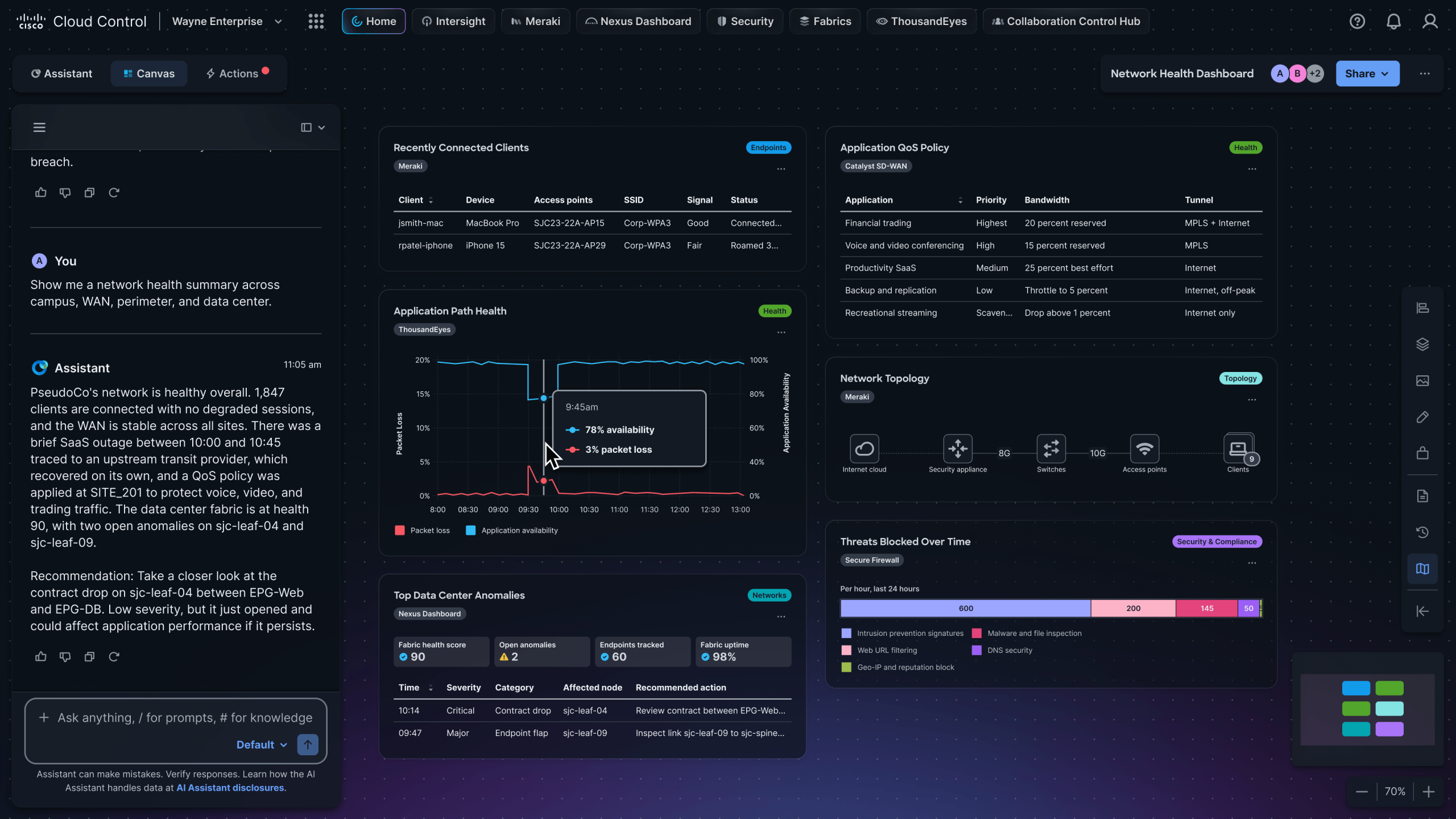
Cisco has unveiled Cisco Cloud Control at Cisco Live, introducing a unified platform designed for an agentic AI-driven world where organizations must operate, respond, and defend at machine speed and scale. The platform is built for both humans and AI agents to manage, monitor, and secure critical IT infrastructure, forming the foundation of Cisco’s new AgenticOps operating model.
Cisco Cloud Control provides a single login and a unified operational view across networking, security, compute, observability, and collaboration within one secure environment. It allows both people and AI agents to work from a shared data layer, ensuring consistent operational context and a unified system of action, while humans remain in control of decision-making. The platform also enables customers to build custom applications and agents using natural language, while integrating with a broad ecosystem that includes AWS, Microsoft, Google Cloud, PagerDuty, ServiceNow, Slack, Linear, and Wiz.
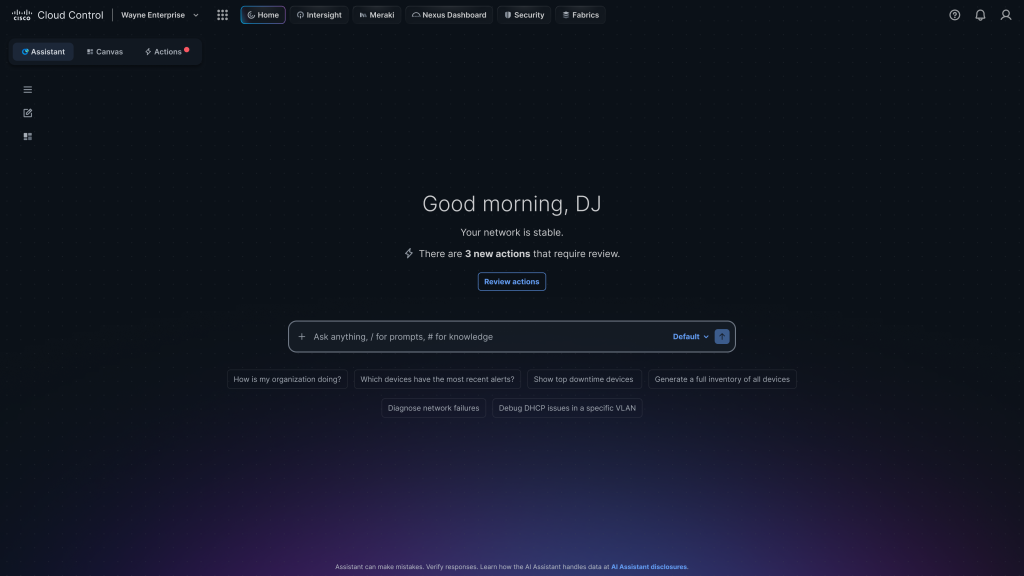
According to Jeetu Patel, President and Chief Product Officer at Cisco, AI agents operate continuously at software speed, fundamentally changing how enterprises scale, manage, and protect infrastructure. He described Cisco Cloud Control as a command center for agentic AI where teams and AI agents collaborate in the same environment with shared information and human oversight.
The platform is designed as a single management plane that unifies enterprise infrastructure into one operational environment. It brings together cross-domain telemetry across networking, security, observability, and collaboration, enabling both humans and agents to act on shared data to improve uptime, manage agent behavior, and optimize operational efficiency. Cisco also highlighted its purpose-built AI models, including its Deep Network Model trained on decades of networking data, designed to scale intelligence according to problem complexity.

Cisco Cloud Control introduces trusted autonomous agents capable of detecting issues, identifying root causes, executing fixes, testing changes before deployment, and validating user experience recovery. These capabilities are supported by features such as Expanded Experience Metrics, Deep Reasoning, Digital Twin technology, and Agentic Workflows, enabling a structured automation loop with full visibility and governance.
A key component of the platform is Cisco AI Canvas, a collaborative generative workspace where operators and AI agents investigate and resolve complex issues in real time using shared live data. Context is preserved across teams and shifts, reducing repetition and improving continuity in operations.
Cisco also introduced Cloud Control Studio, a development environment that allows customers to build agents and applications tailored to their workflows using natural language. Agent Builder enables the creation of policy-driven agents connected to more than 50 third-party tools through native connectors and the Model Context Protocol. App Builder allows users to create and deploy applications using natural language prompts, supported by OpenAI Codex. All builds, along with ecosystem contributions, can be distributed through the Cloud Control Marketplace.
The platform is currently entering controlled availability in the United States, with global availability expected to follow.
In the security domain, Cisco emphasized that traditional reactive defense is no longer sufficient due to the shrinking time between vulnerability discovery and exploitation. The company highlighted its participation in initiatives such as Anthropic’s Project Glasswing and OpenAI’s Daybreak, which are used to test Cisco products against frontier AI models to identify vulnerabilities before adversaries can exploit them.
Cisco also referenced its open-sourced Foundry Security Spec, designed to help defenders apply rigorous AI-driven security evaluation methods. Cloud Control is positioned as the central security command center where real-time defense operations are managed.
The company introduced Live Protect, a system that functions as a digital immune layer for Cisco products, enabling runtime protection against newly discovered vulnerabilities without requiring reboots or downtime. This capability is currently available on N9000 series switches and is expanding across Cisco’s broader portfolio, including campus, branch, and routing systems.
Cisco also expanded its Hybrid Mesh Firewall capability, which provides unified protection across networks, applications, and third-party firewall systems to reduce attack impact and limit risk exposure.
As AI agents become part of enterprise workflows, Cisco is expanding its security framework to protect both agents and systems. This includes developments in AI Defense, Zero Trust for agents, and the Agentic SOC, designed to detect and respond to threats at machine speed.
The company also outlined its roadmap toward quantum-safe infrastructure, addressing emerging threats such as “harvest now, decrypt later” attacks. Cisco plans to enable quantum-safe communications across most of its core portfolio by December 2026, with new infrastructure designed to be quantum-safe by default, including secure boot capabilities for new devices.
Cisco is also introducing Quantum Ready Assessments through Cisco IQ to help enterprises identify vulnerabilities and prioritize remediation. A Quantum Resilience Framework has been established to guide organizations through the transition to post-quantum cryptography.
To support long-term resilience, Cisco Services is launching Resilient Infrastructure Services, which includes exposure assessment, infrastructure modernization, and defense resiliency programs. Cisco IQ is also being enhanced as an AI-powered delivery platform offering insights, benchmarking, and infrastructure guidance, including support for on-premises deployments for organizations with data sovereignty requirements.
Global availability for several of these services and quantum initiatives is planned for July 2026.