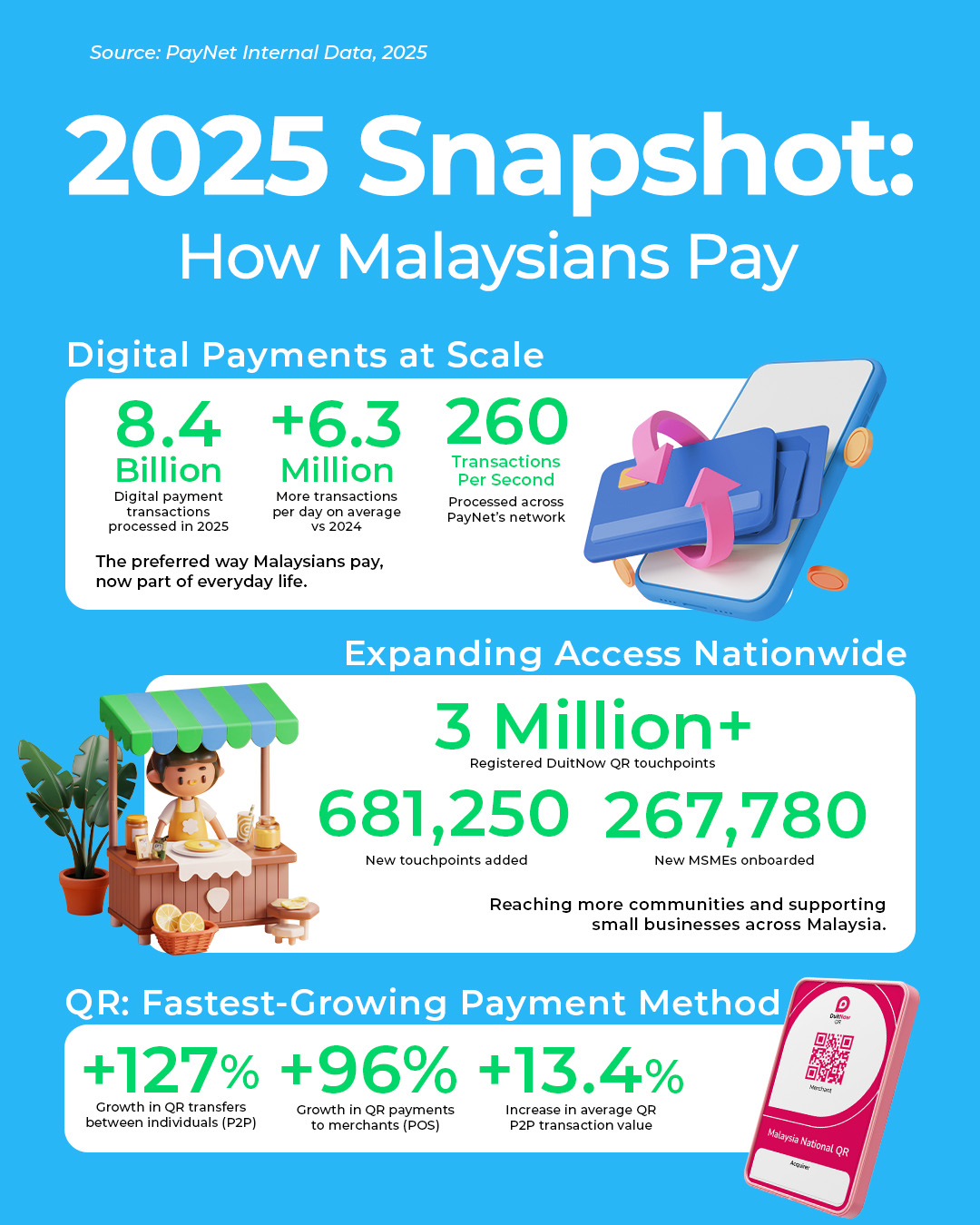
Malaysia’s digital payments landscape continued its rapid transformation in 2025, with Payments Network Malaysia Sdn Bhd (PayNet) processing a remarkable 8.44 billion digital payment transactions. This milestone reflects the growing preference among Malaysians for cashless and digital payment methods in daily life. The trend is being driven by widespread adoption across banks, non-bank players, businesses, and consumers. Digital payments are now deeply embedded in everyday activities, from retail purchases to transportation and peer-to-peer transfers. This shift highlights Malaysia’s steady progress toward a more connected and cashless economy.
The increasing usage of digital payments aligns closely with the national agenda outlined by Bank Negara Malaysia under its Financial Sector Blueprint 2022–2026 and reinforced in its 2025 Annual Report. These frameworks emphasise inclusive access, secure adoption, and the development of a reliable national payments infrastructure. As digital payment usage expands, Malaysia continues to strengthen its foundation for a more efficient financial ecosystem. The focus remains on ensuring that innovation is balanced with stability and accessibility for all users. This long-term strategy supports both economic growth and financial inclusion.

According to PayNet Chief Executive Officer Praveen Rajan, the continued growth reflects a fundamental shift in how Malaysians manage and move money. Digital payments are increasingly becoming the preferred method for consumers, businesses, and even public services. He noted that this transformation is enabled by strong collaboration between banks, non-bank participants, merchants, and government stakeholders. As adoption expands, ensuring reliability, security, and accessibility across the ecosystem remains a top priority. PayNet continues to strengthen the underlying infrastructure to support this national growth.
The expansion of digital payments in 2025 was driven by broader participation across the ecosystem. Bank transaction volumes increased by 30.69%, while non-bank transactions surged by 71.7%, reflecting a more diversified and inclusive payments environment. On average, Malaysia recorded an additional 6.3 million transactions per day compared to 2024. Usage also spiked during festive seasons and year-end periods, showing strong consumer reliance on digital channels. This steady growth underscores the increasing integration of cashless payments into daily life.
Adoption also expanded significantly among businesses and communities, particularly through DuitNow QR. A total of 681,250 new acceptance points were added in 2025, including more than 267,000 among micro, small, and medium enterprises (MSMEs). This brought the total number of DuitNow QR touchpoints nationwide to over three million. Growth was also strong in non-urban areas such as Terengganu, Kelantan, and Kedah, where transaction volumes tripled year-on-year. This demonstrates that digital payments are reaching all segments of society, not just urban populations.
Key initiatives such as PayNet Digital Campus and Cashless Boleh have also played an important role in driving adoption. These programmes integrate digital payments into universities, public services, and everyday environments. Meanwhile, the PayNet Fintech Hub supports innovation by connecting startups, financial institutions, and ecosystem partners. Together, these initiatives help accelerate financial inclusion and strengthen Malaysia’s digital economy. They also ensure that the benefits of digital payments are accessible to a wider population.
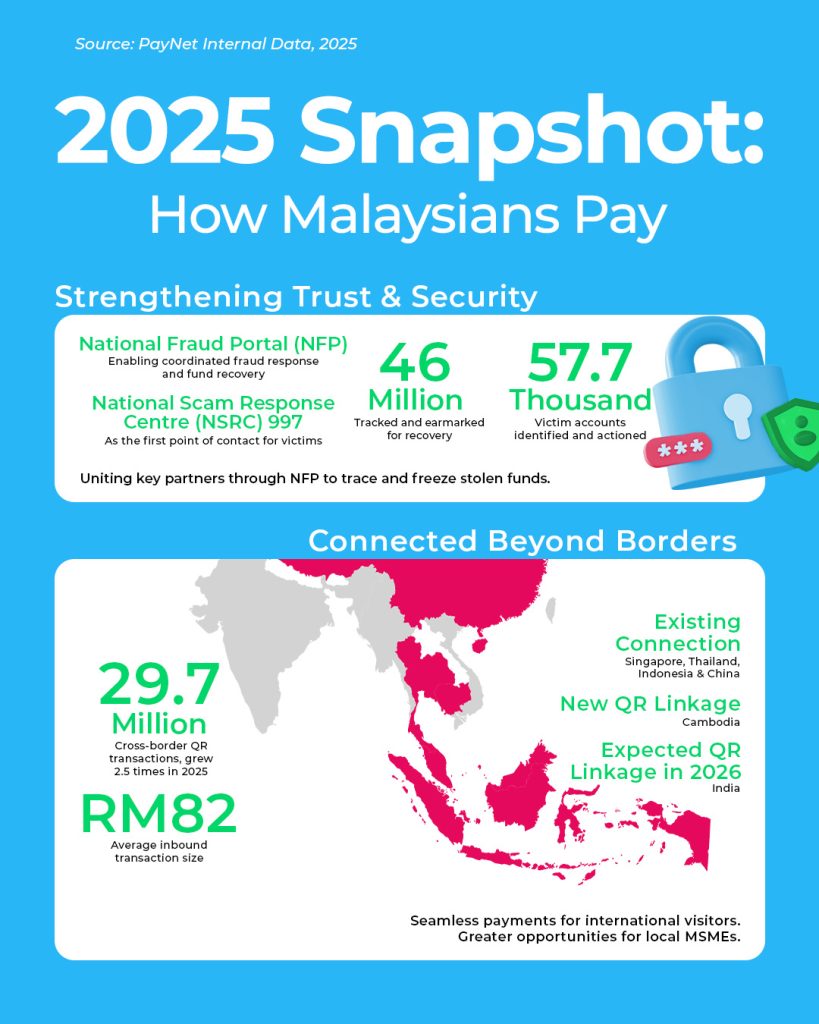
As digital payments grow, cybersecurity and fraud prevention have become increasingly important. The rise of sophisticated scams, including those using artificial intelligence and social engineering, has required stronger industry coordination. The National Fraud Portal (NFP), developed by PayNet, plays a key role in enabling real-time information sharing between financial institutions. In 2025, the system helped identify around 57,700 victim accounts and supported the recovery of approximately RM46 million in funds. PayNet also ensures high system reliability, processing about 260 transactions per second with 99.995% uptime.
Malaysia’s digital payments ecosystem is also expanding beyond its borders through cross-border QR linkages. In 2025, a new connection with Cambodia was introduced, complementing existing partnerships with Singapore, Thailand, Indonesia, and China. India is expected to join in 2026, further strengthening regional connectivity. Cross-border QR transactions grew 2.5 times to 29.7 million in 2025, enabling Malaysian businesses to access a wider regional market. This is particularly beneficial for MSMEs in sectors such as retail, food and beverage, and tourism.
Overall, Malaysia’s digital payments sector continues to evolve into a more inclusive, secure, and interconnected ecosystem. Strong collaboration between regulators, financial institutions, and industry players is driving innovation and trust. With continued investment in infrastructure and security, the country is well-positioned to support future digital economy growth. As adoption deepens both domestically and regionally, Malaysia is steadily advancing toward a more cashless and digitally integrated financial future.